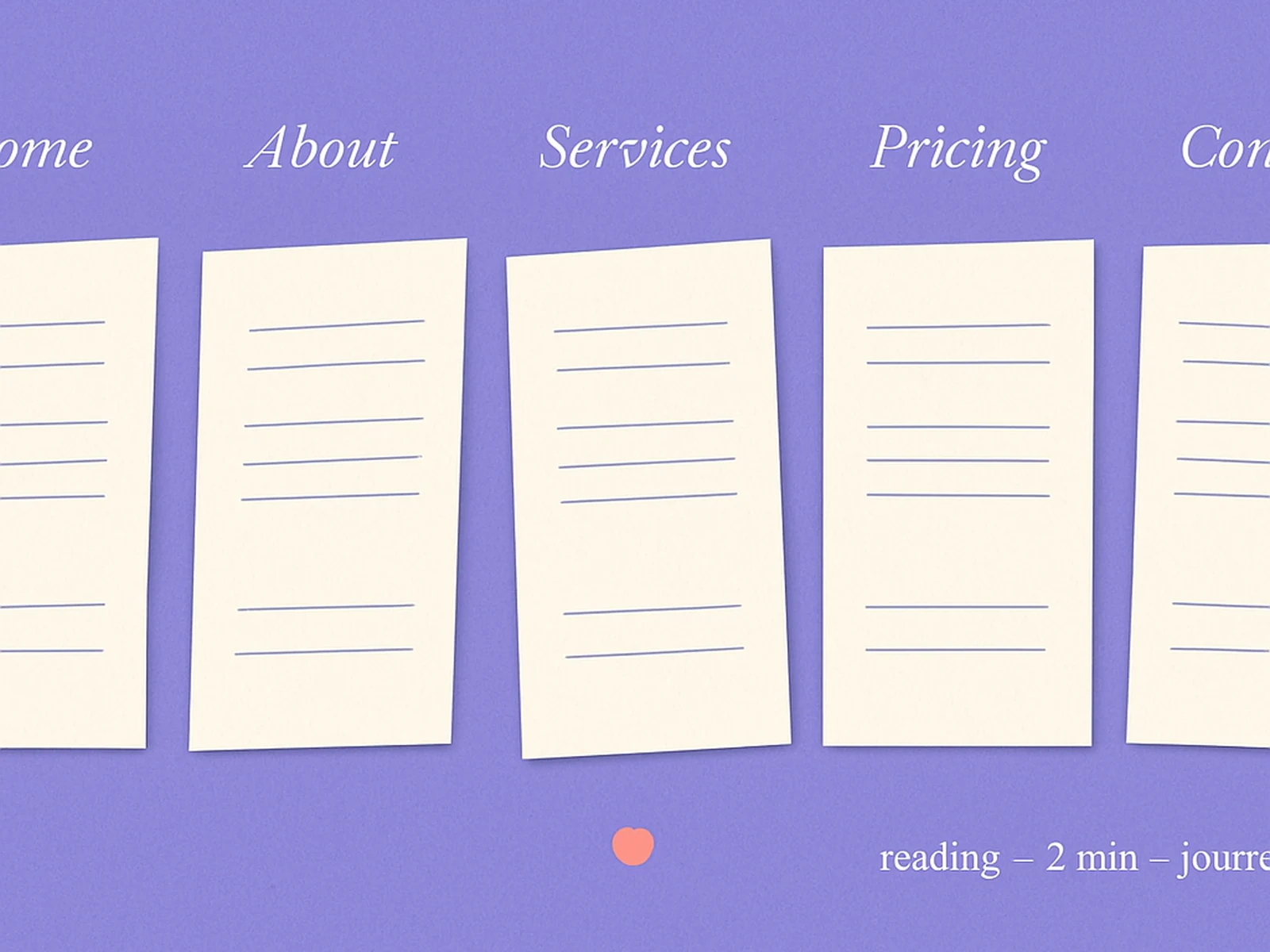
The most common shape we deliver is, almost suspiciously, the same shape. A home page. An about page. A services or work page. A pricing page. A contact page. Five pages. Sometimes six if there is a real reason for a journal or a careers page. Sometimes four if the business is so narrow that one page can do the work of two. But it is, again and again, somewhere around five. I want to argue, in this short essay, that this is not laziness or pattern-following. It is the correct answer to a problem that the industry has talked itself into making more complicated than it needs to be.
There is a category of website that genuinely needs many pages. E-commerce, with hundreds of SKUs. Editorial publications, with a daily output of articles. Documentation sites, where each function gets a page. Product marketing pages for software with a hundred features. These sites need a content management system and a templating layer and an editor workflow, and the design work is correctly oriented around those constraints. We have built sites of this shape and they are real projects with real problems worth solving.
But the website that almost every small business, agency, studio, consultancy, and independent practice actually needs is the five-page object. It is a marketing artefact in the literal sense — a finely-made thing, intended to introduce the business to a stranger, that needs to do that job well and then mostly stay still. It does not need a CMS. It does not need a marketing team. It does not need a feature roadmap. It needs five pages of carefully written copy, five pages of carefully designed layout, and a level of finish that signals the kind of business that thinks about these things. Most of our clients arrive thinking they need the other category and leave understanding that they need this one.
There is a related point about the cost of maintenance. The five-page website, hand-built, lives for years without intervention. The CMS-driven website with the elaborate component library and the editor workflow and the framework choices needs to be touched constantly — security updates, plugin updates, framework breaking changes, editor permission tweaks. Most small businesses end up with a CMS-driven site they cannot edit and which slowly rots until someone is brought in two years later to start again. The five-page hand-built site does not rot. You change the prices when the prices change, you swap a paragraph when something changes, and you leave it alone otherwise. This is, in our experience, what most businesses actually want from their website, even when they have asked for something else at the start.